“Under the Knife” Available Now!

There's pretty much no healthcare joke I can make that won't anger somebody right now...

There’s no time for a second opinion! We must order now!

My life has been a whirlwind of work, work and more work. The job has been hard but rewarding, and the writing has been tough.

But there have been some developments for on the writing. I wrote a few good tales and am working on another two. I’d like to finish the month with three flash pieces. I foresee a writing break for half the month of June.

But there’s one really important tidbit. At long last, it’s finally out. Under the Knife from Cruentus Libri Press is finally out. Click on the picture to order!

Also available for Kindle.

Business

It’s Wednesday at the new job. The paperwork is done, I got a few minutes before lunch and the second part of my day… when I start doing what I was hired to do. What I want to do.

The last couple of weeks have been filled with personal and professional efforts. As of late, I’ve invested my writing on a new publisher, as Cruentus Libri is taking a break for a while. It sucks, but I gave up on doing the sci-fi stories for a bit as I focus on expanding my “writing resume.” The fact is, it’s easier. The little guys feel like they have a better idea of what they want, and often their reduced pay means less competition.

I once got a lesson in the nature of writing competition. I was living in Arlington, Virginia, and one morning, I boarded the bus to work. Along the way, I started talking to a girl and she told me she’s into writing. That was when I mentioned the Black Library submission windows. She got excited, wanting to participate.

Despite not knowing a thing about the nature or details of the 40k universe.

Amateur writers can be hungry like that. Willing to try even if they don’t realize the amount of research they’ll need just to get up to speed, or even knowing anything about a subject. And that’s also why I believe so many professional writers tend to feel and sound so cynical, having done the hard work and effort to research and understand subject matter, as well as fighting through hundreds of other writers and receiving so many rejections.

Not much to do but work at it.

As of late, the game Banner Saga: Factions has really, really been on my mind. It’s a turn based tactical strategy game built around Viking lore and mythos. I’ve really been considering writing a strategy guide (I win more often than I lose), but since that won’t advance my writing career, I won’t. I’ve been thinking there is a teensy bit of money and development to be made on the Indie gaming side and in any gaming series with no existing publishing. The same is true of Fallout and a few other gaming series. I’ve decided to try my hand at gauging some of their interest. But I expect to hear no often.

“The Black Wind’s Whispers” Out Now!

The Black Wind's Whispers, by the Bolthole.

The Black Wind’s Whispers, by the Bolthole.

After months of work, it’s finally here… The Black Wind’s Whispers. Available now on Amazon. (Also in England.)

Included within are nine tales of  horror, featuring new twists on classic monsters, managed by yours truly, James “He2etic” Fadeley. Edited by CS Barlow and Andrew Aston, it features tales by Alec McQuay, Simon Howers, Jeremy Daw, Johnathan Ward, Robbie McNiven and Keanu Ross-Cabrera. Cover art by the amazing Manuel Mesones!

But best of all, it includes a tale from special guest author and veteran horror writer, CL Werner!

Get your copy today from Amazon! Smashwords version coming soon!

Book Marketing and the Future

If I have any regrets the last year, it was that I didn’t start using Twitter until very recently.

Fact is, Twitter is a better marketing tool. Brief, to the point, easy to interact with. It can be linked to Facebook. Rather than engaging in “mutually beneficial” friendship arrangements, you simply have followers which you must attract. There are fewer walls and the actual spread of information is way more open, where as Facebook applies an algorithm to reduce clutter on people’s walls (which can filter you out).

Twitter is actually kind of essential for those reasons. Without walls, fans can connect readily with authors and creators. Although one can get in trouble with the platform, there is quite a bit of power to be harnessed if used carefully.

As I move forward with the anthology, I’m also hacking away at other needs to promote it. I’m examining advertising costs on Facebook. But more importantly, I’m looking at various book reviewing bloggers. Although there are “big name” critics out there in the newspapers, these smaller guys often tend to be quite niche, and really hit the reader bases that we’re writing for. In a way, the smaller guys can be a lot more powerful than the big names, because they know what they want.

This is why, despite an age where anyone can publish anything thanks to Amazon, publishing houses are not going away. They have the power to provide advertising and superior editing services. They usually know their market, and can tap top talent if need be. Self published success have occurred and will continue to happen, but there are services that publishers provide that simply aren’t available to the average author.

Business is really all about networking. Knowing the guy who can do what you can’t, knowing the right people for the job. All of us, especially writers, have to be in business for ourselves. And despite potential competitive aspects of business, a lot of it is also about working together.

Speaking of business, I’ve been thinking about what I’ll be doing next year. I’ve mentioned trying a few drafts against Everyday Fiction. But Narrativium will be in charge of the next anthology, Marching Time. Besides that, there will be the Black Library submission window, of which both myself and several of the Boltholers will have our strongest chance next year to be published.

The major question is whether to attempt my first novel, or self-publish an anthology of novellas. The latter is very tempting. My approach to being published has revolved around an “evolving plan” of difficulty. Flash fiction and short stories started it. There has been at least one novella thus far.

An idea is to go ahead and write more novellas, and get used to longer tales before attempting a novel-length story. Length is a major factor. 300 pages is nothing to sneeze at. My approach has really allowed me to gradually increase the difficulty, while building on the skills I’ve learned in the previous steps.

What I learned from short story telling can be applied to novellas. What I learn from novellas could evolve into a novel. Thus far, that idea has been working. While I don’t want to be complacent, this approach is working thus far.

Morally Nihilist

Yesterday, I was having a debate with a few people about the concept of morality. It’s amazing how a debate about politics can quickly descend into ad hominem attacks and snide, subtle insults, but philosophy and morality can be discussed with a rational calmness that I find enlightening.

During the conversation, I clarified my morally absolutist position against a more relative position. But the intrigue came from user “Mossy Toes” whose claimed to support relativism but whose arguments sounded more in line to nihilism. I ended my point teasing, “Easy there, Joker.”

“Why so serious?” Mossy replied back. I turned down his offer to discuss it on the debate lounge for the time being. But I gave the manner some thought throughout the night and in the morning. Moral nihilism is difficult to discern. A kind of catch-22 of reason that is tricky to define or at least prove.

Why is nihilism so tricky? When you deny the concept of morality in general, there is still a cold assertion of logic that can serve as a basis of morality. Mossy Toe’s view was built around the biological juxtaposition of humans as animals, which is true. He cited a few examples of moral absolutism being undone by circumstances which challenge such values and find its believers wanting, such as a starving civilization finding the sacrifice of its children as noble, or even a moral duty.

You may live in the jungle and adhere to no “delusions of morality” as Ian Holm‘s character put it in the movie Alien. But that still creates a fundamental paradox, an acceptance of the survival of the fittest. Hence you have that ah ha moment, where in denying morality, you inherently accept a much simpler code of it instead.

As I considered that, I found myself thinking about the man who has been on everyone’s mind since 2008. Heath Ledger‘s version of the Joker was a triumph of moral nihilistic thinking, at least in his ability to challenge everyone else’s moral standings.

That was his raison d’être.

For anyone who has seen the film, which drew inspiration from Alan Moore’s The Killing Joke, the Joker’s real goal was to render away everyone’s morality. His approach was simply to create the extreme circumstances of which test our sense of what is right or wrong. Kill this man or he’ll blow up a hospital. Blow up the other boat and he’ll let you live. Take off your mask or he’ll kill someone.

Perhaps the Joker did bow to the “survival of the fittest” concept, but his application of nihilism was to scrub away the veneer of morality that people apply to maintain some order in their lives.

Moral relativists can be harder to break for that reason: They would often have an easier time accepting that the circumstances were dire and justify normally abhorrent actions. What works, works, as pragmatists would say. But sooner or later, they will get backed into a corner where they find, at the base of the flexible set of acceptable standards, a morally absolute bedrock that they will not cross. The line in the sand.

I would imagine that most, though not all, moral absolutists are like eggs. They might have some loftier views of ethics, but in the face of a moral test, they crack quickly. And are left with a hypocrite’s shame of being unable to live up to their own expectations.

But then there are those moral absolutists who hold on. Batman, with the exception of when he almost turned himself in, could be described as morally absolute. The kind of grounds we usually think of when we devise heroes and protagonists. We often mock people who publicly declare their values, because we’re so used to being let down. It takes action, not words, to define one’s position. Conviction must be proven.

I’ve often found that people tend to have the highest respect for moral absolutism whenever we can legitimately hold onto it. When we don’t bow to the pressure compromise with our integrity.

And that, of course, is the hard part.

Cover Art of New Anthologies

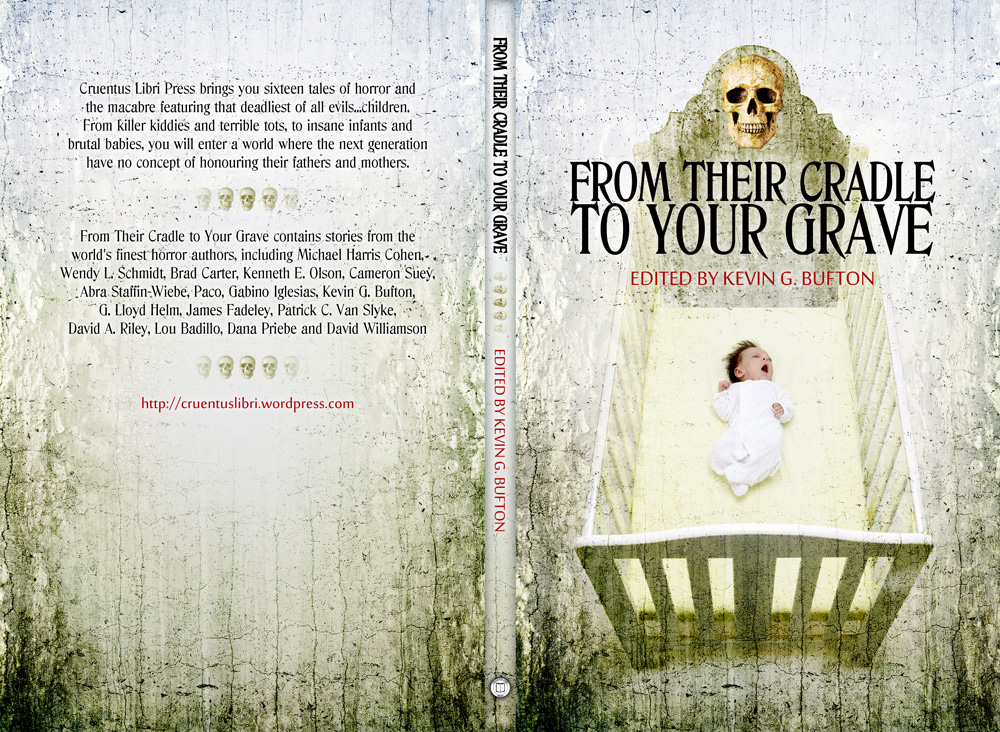
Babies require a lot of care. Diapers, food, love, it’s quite a bit. But sometimes, you get a special child. Sometimes, you’ll need holy water, fire, sunlight, garlic, silver bullets and girded loins. Cruentus Libri Press is firmly aware of the difficulties such children can be, and thus have concocted an anthology of cautionary tales to prepare the lucky parents of monster babies.

"Aw look at em! He's a coconut this guy..." -Famous Last Words

“Aw look at em! He’s a coconut, this guy…” -Famous Last Words

But wait! There’s more! As if horror tales involving pint sized sociopaths weren’t enough, we can even bring in the family doctor! Also including a story by yours truly!

There's pretty much no healthcare joke I can make that won't anger somebody right now...

On the bright side, your HMOs got this.

Look for both these new anthologies this month!

Nietzsche’s Abyss

A saying I have heard a few times in my life goes, “All it takes for evil to win is for good men to do nothing.”

But do we take for granted that there will always be good men? Morally, we’re often at a loss about how to define things as good and evil. Nor does the absence of evil necessarily mean good, for there are often large swathes of moral gray from within which we ponder our existence.

Very often, we tend to lighten evil by reason and justification. The phrase, “Greed/Money is the root of all evil” is one such example of this. In my life, I’ve read stories of men and women who have engaged in acts that, by our current definitions of rational or moral, are anything but. Criminal psychologists have invested hours, years and lifetimes trying to answer why.

The more you stare into this abyss of the irrational, the more tiring it becomes. I’ve looked down there many times in my life, and I’d imagine everyone has once or twice, if only to have a comparable standard that clarifies the difference of sanity to its opposite.

Only a mind can hold the untruth. A symbol in the equation whose values shift and alter without logic or reason. The chaotic black box against which even the same formula results in different values. In reality, there is an equal or opposite reaction for every action. But this symbol stands in defiance against such natural truths.

Regardless of the existence of this chaos in every mind, we build a structure of rules and thinking within the framework of our minds, a framework of which is our accepted school of morality. They may differ, but we all have a set of morals, defined by both their existence or lack there of.

With regard to evil,  four major schools are moral thought exist: absolutism, nihilism, relativism, and universalism.

Absolutism is the belief that certain things are absolutely always wrong, such as murder or stealing. Relativism is the the comparison and tolerance of differing sets of behavior. Universalism is embracing a set of standards for all people. Nihilism is the inherent disbelief in any sense of right or wrong.

These four schools do not always compete or disagree. Absolutism can be compatible with universalism, but that is not always true. And furthermore, some may apply varying schools to varying actions. For example, a person who believes that killing is wrong at all times may apply absolutism to situations that could be self defense or the death penalty. But then the same person may feel relativism when answering questions about two men stealing bread, one because he can and the other to feed his family.

When it comes to villains, we often apply a rationality for their actions which smacks of relativism from a lower set of moral standards. That for some reason, they have compared their situation to others and feel in some ways justified in their actions. The world has done them wrong, so they feel justified in stealing to survive, at least from a particular group or people.

Absolutism and universalism can also turn dark. Absolutism can be raised to arrogance, justifying the righteousness of one on the belief that their decisions are good. Universalism too in the application of “moral truths” against everyone, whether they wish it or not.

Nihilism is particularly unique in that denying the existence of morals, it can become the very evil that all other schools of thought fear. A person with absolutely no morals may choose not to kill or steal out of logical consideration of the legal consequences. But in a state of weakened administration of the law or straight anarchy, such individuals can easily be quite dangerous.

Morals are the basis of both good and evil.

Technically, the temple of morality every person builds for themselves becomes suspect the moment that any untruth is laid upon it. Especially when a truth dispels an falsehood that is the basis of that very foundation. But anyone who has ever had an argument before knows that a person’s moral standing does not collapse when confronted with evidence of it’s incorrectness.

The psychological term we apply for this phenomenon is cognitive dissonance, the attempt to justify and “correct” the original assumptions of our thinking, rather than to accept and rebuild our understanding of morality and truth.

But the abyss I mentioned before is always there. Like a black, light absorbing sun, its illogical is the bane of all reason and all knowledge. It does not inverse truth; it makes truth meaningless. There are many terms for it. The schism of interloping consciences. Biological psychobabble. Madness. The chaos from which the universe sprung.

Who knows.

There is another psychological term for what this abyss can create. It is called metanoia, the breaking down and restructuring of one’s mind frame. A kind of reconciliation of the mind to the facts. Perhaps this abyss is the pit where we toss the truths we dismiss until it gross and consumes the temple of morality and leave the ground afresh to begin again.

I suspect there will always be those however, that are absorbed by the abyss and never reemerge. Maybe they go catatonic or insane. Maybe what comes out of it is worse than before. Some reach down into the abyss and pull back a hand of water from which they clean themselves of the impurities they have wrought upon themselves.

Most I suspect, fall and never come out.

“When you stare into the abyss the abyss stares back at you.”
-Friedrich Nietzsche

Recalculating

When it comes to publishing work, I like this pace.

The year is going to end with an explosion of new work. Two pieces are already in the bag for Cruentus Libri Press. Another work, the anthology by the Bolthole, should be out either on time or very close to it. Finally, there is one more piece of work that has been turned in to Cruentus Libri, that has received the thumbs up from two reviewers.

If that final piece gets published, that’s six finished works before 2013.

Although I am pleased, it is a good time to stop, check the map and consider the direction I am taking. All six of these pieces have been horror, which I enjoy writing. I prefer a mix of darker and more subtle horror stories, with a willingness to explore themes rather than enact gore fests.

Many of my friends have also pumped the breaks, declaring that although they are enjoying our work, they do not wish to do horror for the rest of their lives. Rather, their interests are towards varying forms and degrees of science fiction. Myself, recall that I have neglected my dark swords and sorcery tales. They remain untouched since sometime late last spring.

Once the anthology for the Bolthole is complete, a break is due that will probably last until the new year. Although I’ll probably continue to send work to Cruentus Libri, I may start searching for other, non-horror publishers to submit work towards. I’ve tried before and it seems more difficult to try with science fiction or fantasy.

I cannot say why horror seems so oddly forgiving. Perhaps they are just more open to the various definitions of what constitutes horror. But, I feel the need to challenge myself. And that is what I will endeavor to do.

Stranded

My car died in Philadelphia.

It’s already been towed to a storage place where it will be taken to a shop a little later this morning. The problems occurred just as we were leaving last night. We were fortunate that the car came died while we were looping around the same hotel we stayed at.

The tow truck guy showed me part of the issue. The battery was dying, but not yet dead. For a while, the inside lights, power locks and features still worked. He shook the power cables, pointing out they were loose. We still couldn’t get it started.

Best case scenario, we need a jump and the cables need to be tightened. Second best is the cables just need replacement. Bad situation is the alternator needs replacement. Worst case? Starter too. Though I doubt that. We know for certain that the battery will need attention at least, so we’re not in the dark on this.

Finishing my draft will be held up. But there’s still time. Will have to spend the next few nights hacking away at it.

Death and Rebirth

In two days, I’ve completely rewritten a little over half my story for The Black Wind’s Whispers anthology.

The original draft was poor. Very poor. It basically just got at an idea that I wanted to introduce at a distinct time period, starring a member of the London police service. The result was a slapdash affair that failed to deliver anything but clichéd drivel. The ending of it works, which is technically the important part, but what we need is a real story with plot, depth and intrigue.

So the last few days were spent rewriting it from the ground up. The general plot outline hasn’t changed much, but it has been considerably fleshed out: There have been stronger additions of legitimate police work, more backstory given to the characters and victims. Needless parts were dropped, important scenes were broken apart and enriched. There’s more showing than telling now too, much more.

Of interest is the historical research. I’ve done some digging on certain laws, applied some historic facts to the story to help it get into the 70’s. I’ve even added a very important historical figure, who has had a critical support role, and has added a fair bit of flavor to the times. Notes added by a friend, who happens to be  a member of the (current) London police force has really helped bring about the authenticity of the story.

Research is the most important aspect of writing a great time piece it seems. I was bad about that before, but I’m getting better at it. Copywriting is a difficult and expensive task. But reading over the changes to my work, I suspect my editors will be more pleased.

Still, it’s not yet complete and there are three things to consider. First, the ending structure is similar but with a new scene added, changing the dynamic of an enigmatic yet helpful character. Second, the general writing of the second part must be improved. I must be in no rush to finish. Third and final, I must finish soon and leave time for a rewrite.